
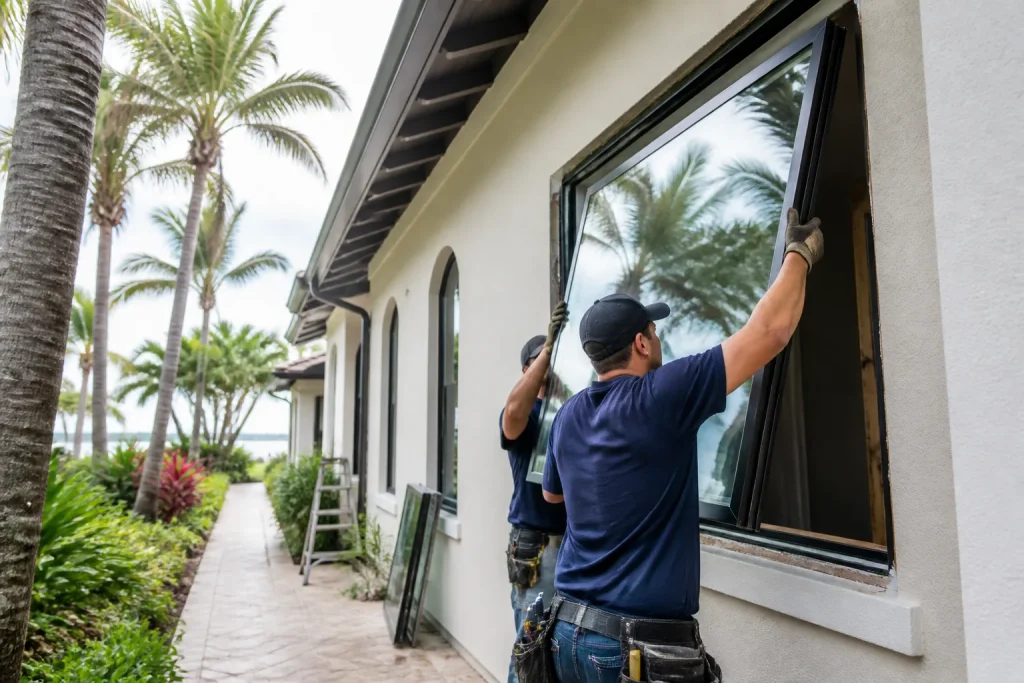
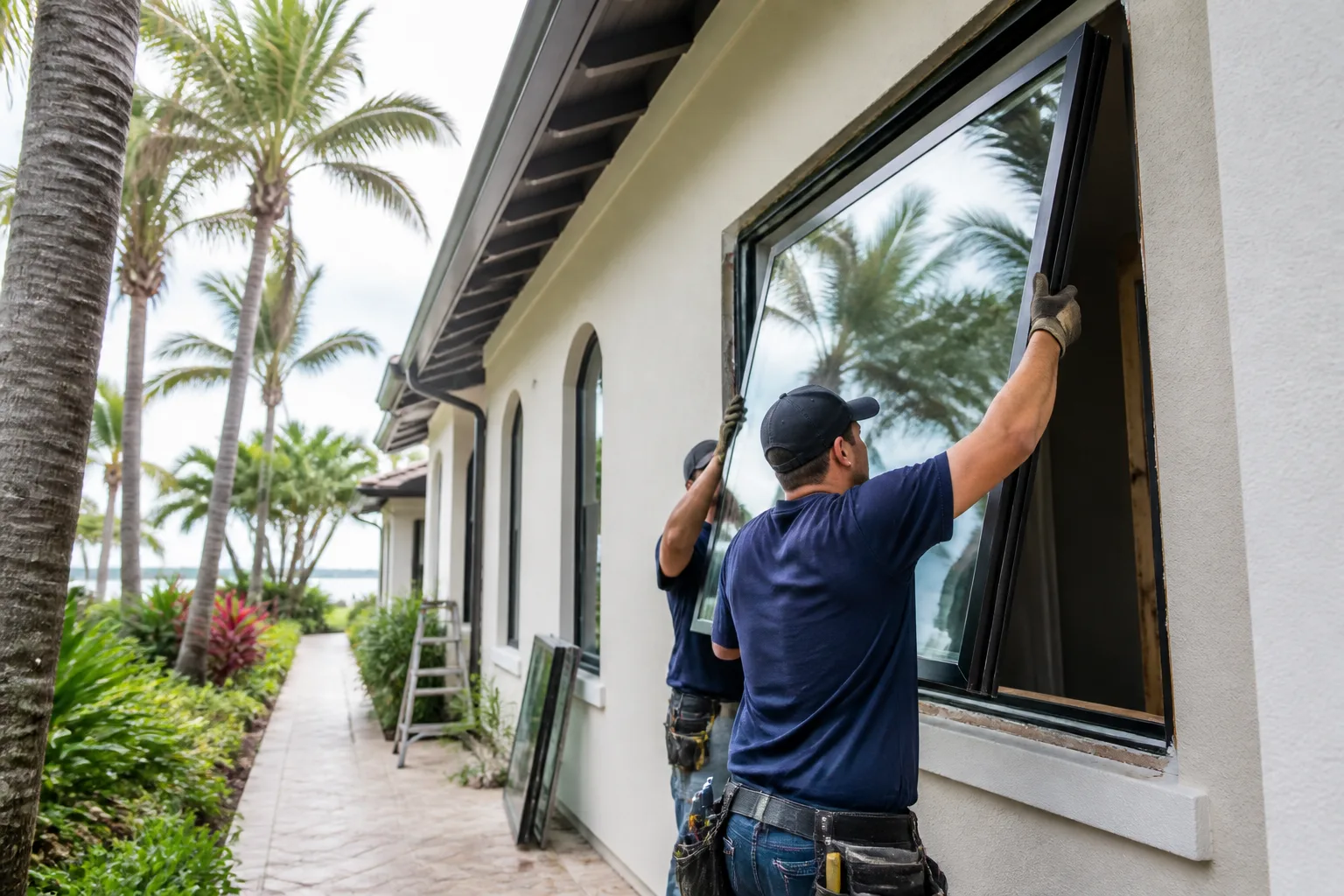
Emergency Window Installation Near Me: What Palm Beach Homeowners Should Do First
If a window just blew out or got kicked in, your first job is not to find a contractor. It’s to photograph the damage, shut off any air handlers near the opening, and cover the gap in a way your insurance adjuster will accept. Get those three things done before you call anyone, because the first 90 minutes after a breach determine whether you recover cleanly or spend six months arguing over a claim that got denied because the evidence was disturbed. If you’d rather not sort through this under pressure, call (850) 801-5596 and we’ll walk you through it.
We’ve been doing emergency window and door work in Palm Beach since before the 2008 founding of TruePane Windows & Doors home became official. The calls come in at every hour: a palm frond through a bedroom window during a squall, a sliding door that shattered when a lawn mower threw a rock, a break-in where the glass held but the frame didn’t. The homeowners who come out ahead are the ones who slow down for about 20 minutes and do four things in order. Here’s the sequence.
Key takeaways:
- Photograph everything before you touch anything. Insurance adjusters in Palm Beach need pre-remediation photos.
- Board-up is temporary. Palm Beach County code limits how long temporary coverings can stay, and you’re liable if one fails.
- Emergency installs in Palm Beach still need permits and HVHZ-approved glass. A quick-ship unit without a Miami-Dade NOA number can fail inspection and void your claim.
- Ask three questions before signing anything after hours: permits, impact rating match, warranty in writing.
What Counts as a Window Emergency in Palm Beach?
Most homeowners assume an emergency means a gaping hole in the wall. That’s certainly one. But in Palm Beach, the definition is broader because the stakes are higher. Humidity alone can wreck drywall, insulation, and subflooring within 48 hours of an unsealed opening. Add rain and wind-driven salt air, and you’re looking at mold behind the casing within a week. So from our perspective walking these homes for over 42 years, an emergency is any breach that exposes the interior to outside air, any impact-rated window that has cracked but not shattered, and any unit whose frame has buckled enough to let water run down the interior wall. A crack that hasn’t broken the seal is not an emergency. A crack that lets humid air through is.
One thing we tell homeowners in Palm Beach: if you can see light through a crack, or feel air moving across it with the AC on, treat it as an emergency. The damage compounds hourly, not weekly.
Step One: Document Before You Touch Anything
This is the step most skipped, and it’s the one that costs homeowners real money. Insurance adjusters working Palm Beach claims look for pre-remediation documentation. That means photos and video taken before you sweep up glass, before you tape a tarp, before you put a board over the opening. If the only photos you can produce show the opening already covered, an adjuster can argue the damage extent is unverifiable. That’s a reduction. In some cases it’s a denial.
Take three sets of photos. First, wide shots from both inside and outside that show the entire wall and the surrounding room. Second, close-ups of the glass break pattern, the frame condition, and any debris field. Third, a video walkthrough starting outside and moving through the room, narrated with the date and time. Then write down the sequence of events while it’s fresh. When did it happen? Was anyone home? Did you hear glass break or did you just find it? All of this becomes part of the claim record.
Only after that documentation is done should you move to securing the opening.
Step Two: Board-Up, Temporary Glazing, or Both?
There’s a real difference between the two, and Palm Beach County code treats them differently. A board-up is plywood or storm paneling screwed or nailed over the exterior opening. It’s a temporary safety measure, and county code generally permits it for a limited window, typically 30 days, while permanent replacement is arranged. Temporary glazing means fitting a piece of glass, often non-impact-rated, into the existing frame so the home can be occupied while the permanent unit is ordered. Temporary glazing can stretch longer, but it carries risk: non-impact glass in a Palm Beach home during hurricane season is a liability. If that temporary glass fails and injures someone, the liability question gets complicated fast. The contractor who installed it, and in some cases the homeowner who accepted it, can be named.
Here’s the rule we give homeowners: if the permanent replacement is going in within a week, board up. It’s cheaper, faster, and keeps the claim clean. If the lead time on the right replacement unit is longer, temporary glazing may be the better call, but only if the temporary glass is clearly marked and only if the homeowner understands the window is not storm-rated until the permanent unit arrives.
We pulled a temporary panel out of a home in El Cid last month where another company had put non-impact glass in a PGT impact frame and told the homeowner it was “just as good.” It isn’t. It passed nobody’s code.
Step Three: Permits and HVHZ Product Approval Still Apply, Even at Night
Palm Beach sits inside the High-Velocity Hurricane Zone, or HVHZ. That designation is not optional. Any replacement window or door in this area must meet HVHZ product approval standards, and any emergency install still requires a permit. A contractor who tells you the permit can be sorted out after the fact, or that the job is too urgent for permits, is handing you a code violation you’ll own when the inspector comes around or when you sell the house.
How do you verify a replacement unit meets code? Ask the contractor for the Miami-Dade NOA number, the Notice of Acceptance number for the specific product they’re proposing. Give you the NOA, and you can look it up on the Miami-Dade product approval database in under ten minutes. No NOA number, no legitimate install. This is the single fastest filter to separate a real Palm Beach glazier from someone who’s going to throw in whatever glass the supply house had on the shelf.
We register both manufacturer warranty layers in writing and state the durations before the truck leaves, on every job including emergencies. We check the NOA number on the unit against the opening because an impact window that doesn’t match the original’s rating is a downgrade you’ll feel in the humidity and hear in the roar of the next storm.
Step Four: What to Ask Before Signing After Hours
Emergency situations breed rushed decisions. Some contractors count on that. The fastest way to protect yourself is to slow the paperwork down and ask three questions. No legitimate installer will balk at any of them.
First: “Do you pull the permit, and can I see the number once it’s filed?” In Palm Beach, someone has to. If it’s not the contractor, it’s you. Second: “Does the replacement unit match the impact rating of the original?” Here’s the thing. A builder-grade impact window and a PGT or CGI or Marvin unit can both be HVHZ-approved yet carry very different design pressures. The original window’s rating matters. If the original was a DP-50 and they’re quoting a DP-35, that’s a downgrade and your insurance carrier may note it. Third: “Is the warranty in writing, and will you register both layers before you leave?” Verbal warranties are worth the napkin they’re written on. The Keystone Standard we hold to means both manufacturer warranty layers registered in writing, durations stated, and a 90-Day Done Right Promise behind the workmanship. No paperwork fights, no fine print that covers neither.
If a contractor hedges on any of those three questions, that’s information. Slow down and call someone else.
Using Insurance to Pay for the Right Permanent Install
This is where a lot of Palm Beach homeowners get steered wrong. When an adjuster approves a claim, the pressure is on to close the file. Some contractors will offer a “quick-ship” replacement that arrives faster because it’s a generic or lower-rated unit. The insurance money covers it, the opening gets closed, and nobody talks about whether that window actually belongs in that house. A year later the homeowner notices the new window fogs on summer mornings or the frame binds in July, and the contractor’s phone number doesn’t work.
Your insurance policy is written to restore the home to its pre-loss condition. Pre-loss condition includes the impact rating, the glass type, the frame material, and the thermal performance that existed before the loss. If your old window was impact-rated PGT with low-E glass, your policy covers impact-rated PGT with low-E glass, or comparable from another manufacturer like Marvin or Milgard. It does not cover a $200 builder-grade single pane just because it ships in four days.
Read the adjuster’s scope of loss carefully. If it lists a generic “replacement window” without specifying the rating or performance tier, call and ask for the scope to be revised before you sign any contractor agreement. This one phone call routinely saves Palm Beach homeowners thousands of dollars and a year of drafts.
Window Installation in Palm Beach includes permanent emergency replacement done with the right paperwork: permits pulled, NOA number verified, both warranty layers registered in writing. We also handle Door Installation in Palm Beach for the same reason: a sliding door breach has the same 90-minute clock as a window breach, and the same code book applies. If the damage is older and you’re planning a full upgrade rather than an emergency fix, Window Replacement in Palm Beach walks through the options with side-by-side quotes on paper.
When to Call a Pro
If the window that failed is above the first floor, call a pro. Ladders and broken glass are a bad combination at any hour, and worse in the dark. If the opening is load-bearing or near a corner, if the frame is more than an inch out of square, or if water has already run down inside the wall cavity, the fix is no longer about glass. It’s about the structure. We’re not going to give a homeowner step-by-step instructions on pulling a frame out of a bearing wall. That’s how people get hurt and houses get worse.
A live person answers our phone 24 hours a day, seven days a week. Not a voicemail tree, not a callback form, not a regional call center. You’ll get someone who knows Palm Beach, knows the code book, and can tell you whether the board-up can wait until morning or needs to happen now. That call is free.
The Bottom Line
An emergency window in Palm Beach is a sequence problem: document, secure, verify, contract. Skip the documentation and the claim weakens. Skip the permit check and the code violation is yours. Accept a quick-ship unit that doesn’t match the original’s impact rating and the insurance money just bought you a worse house. These are the mistakes we’ve spent over 42 years watching homeowners make, and they all happen in the first 90 minutes.
If you’re in Palm Beach and dealing with a window breach, we offer free estimates. Background-checked, uniformed technicians measure every opening twice, quote manufacturer lines side by side on paper, and register both warranty layers before the truck leaves the driveway. Call (850) 801-5596 and talk to a person. If the pane is not true, the job is not done.
Frequently Asked Questions
Emergency window replacement in Palm Beach typically runs $400 to $1,800 per opening for the permanent unit, depending on glass type, frame material, and impact rating. Board-up before replacement generally adds $100 to $300. A PGT or CGI impact unit will sit at the higher end. The bill climbs when the job requires a permit expediter or when the opening is on a second floor. Call (850) 801-5596 for an exact quote on your opening. Estimates are free.
Sometimes, if the right unit is in local stock and the opening is standard. More often in Palm Beach, the board-up or temporary glazing happens day one and the permanent unit goes in three to ten days later, because the unit has to match the original’s HVHZ rating and that usually means ordering from the manufacturer. A contractor who promises a same-day permanent install may be cutting the rating corner. We’ll give you a straight answer on the phone.
Yes. Palm Beach requires a permit for window replacement, including emergency work. The replacement unit must also carry a Miami-Dade NOA number, which proves HVHZ product approval. Before you sign anything, ask the contractor to show you the permit filing and the NOA number for the exact unit they’re proposing. If they can’t, that’s your cue to slow down. Call (850) 801-5596 and we’ll verify the paperwork with you.
Your policy is written to restore the home to pre-loss condition, which includes the impact rating, glass type, and thermal performance of the original window. The carrier should cover a comparable replacement, not a downgrade. The most common reason for short payments is a scope of loss that lists a generic unit instead of the specific rating. Review the adjuster’s scope before accepting any bid. If the paperwork fight starts, we’ll help you document what the original window actually was.
Written by Dale Kessler, Owner at TruePane Windows & Doors, serving Palm Beach since 2008.
Need Windows & Doors Help?
Call TruePane Windows & Doors - licensed & insured, here with fast after-hours help in Palm Beach.
(850) 801-5596